The Education Department of the Government of Gujarat runs an excellent scheme for brilliant students. This scheme is the Mukhyamantri Gyan Sadhana Merit Scholarship (CGMS) Scheme. The Government created this program to support students from economically weaker sections. This financial help allows poor students to complete their higher school education. The program gives regular financial support from Class 9 to Class 12.
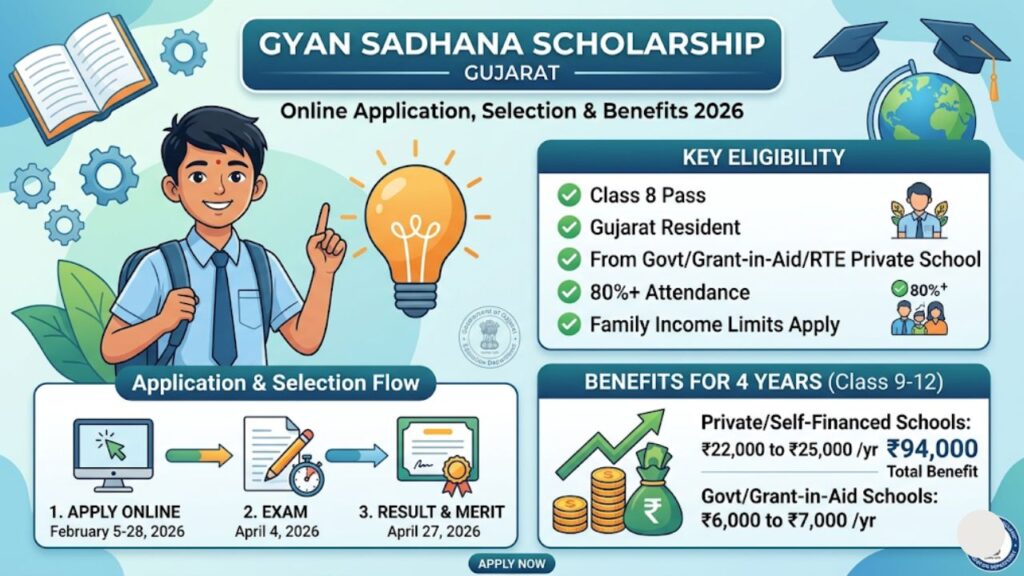
The State Examination Board (SEB), Gujarat manages this exam-based scholarship. Every year, thousands of students apply for this exam to secure their future. This article shares complete details about the application process, qualification criteria, important dates, and scholarship amounts.
What is the Gyan Sadhana Scholarship?
The Chief Minister Gyan Sadhana Merit Scholarship encourages students to continue their education. Many students drop out of school after Class 8 due to a lack of money. This program solves that problem completely. The State Examination Board conducts a competitive written entrance test every year.
The authority selects 25,000 meritorious students through this merit-based entrance exam. The selected students receive money directly into their bank accounts every year. The scholarship covers four years of education from Class 9 to Class 12. Students can study in government, grant-in-aid, or self-financed private schools after winning this reward.
Key Highlights of Gyan Sadhana Scholarship 2026
You can find the basic details of the scholarship program in the table below:
| Particulars | Details |
| Scheme Name | Chief Minister Gyan Sadhana Merit Scholarship Scheme (CGMS) |
| State Name | Gujarat |
| Conducted By | Education Department, Government of Gujarat |
| Exam Authority | State Examination Board (SEB), Gandhinagar |
| Target Students | Class 9 to Class 12 Students |
| Total Selected Students | 25,000 Students Every Year |
| Selection Process | Offline Competitive Entrance Exam (MCQ Based) |
| Application Mode | Online Only |
| Official Result Portal | www.sebexam.org / cgms-portal.gujaratvsk.org |
Important Dates for CGMS 2026-27
You must remember the exact dates to complete your admission and choice filling on time. Look at the timeline for the current session:
| Event | Date |
| Official Notification Date | February 3, 2026 |
| Online Application Starts | February 5, 2026 |
| Last Date to Apply Online | February 28, 2026 |
| Gyan Sadhana Exam Date | April 4, 2026 |
| Provisional Answer Key Release | April 7, 2026 |
| Final Answer Key Release | April 21, 2026 |
| CGMS Exam Result Declaration | April 27, 2026 |
| Final Merit List Release | May 9, 2026 |
| Round-1 Choice Filling for Private Schools | May 8, 2026 to May 15, 2026 |
Also Check: Dr. Rajendra Prasad Scholarship Program
Scholarship Benefit Amount Structure
The government pays different amounts based on the type of school the student chooses. Private school students receive a higher amount to cover tuition fees. Government school students receive an amount to cover books and basic materials.
The complete money structure follows these rates:
1. For Private / Self-Financed Schools (Admitted under Merit)
- Class 9 to Class 10: ₹22,000 per year
- Class 11 to Class 12: ₹25,000 per year
- Total Benefit for 4 Years: ₹94,000
2. For Government or Grant-in-Aid Schools
- Class 9 to Class 10: ₹6,000 per year
- Class 11 to Class 12: ₹7,000 per year
- Total Benefit for 4 Years: ₹26,000
Eligibility Criteria for Applicants
Students must satisfy the following conditions to join this scholarship scheme:
- State Residency: The applicant must possess a permanent residency certificate of Gujarat.
- School Education: The student must complete Class 1 to Class 8 continuously from a Government school or a Grant-in-Aid primary school.
- RTE Students: Students who study in private schools under the 25% quota of the Right to Education (RTE) Act 2009 can also apply.
- Attendance Level: The student must maintain a minimum of 80% attendance in Class 8.
- Family Income Limits: * For Government School Students: No income limit applies.
- For RTE / Private School Students (Rural Areas): Maximum family income up to ₹1,20,000 per year.
- For RTE / Private School Students (Urban Areas): Maximum family income up to ₹1,50,000 per year.
- Gender Reservation: The scheme reserves 50% of the total seats for female students.
Also Check: ONGC Scholarship 2026
Essential Documents Needed for Registration
Keep these documents ready before starting the online application form:
- Student Aadhaar Card (Linked with school records)
- Class 8 Marksheet or Student Progress Card
- Family Income Certificate (Issued by a competent government authority)
- Gujarat Domicile Certificate / Residence Proof
- Student Unique DISE ID (Child Tracking System – CTS Number)
- School DISE Code
- Caste Certificate (For SC, ST, or OBC categories)
- Recent Passport-size Photograph of the student
- Student or Parent Bank Account Details (Passbook copy)
- Valid Mobile Number of Parents and Class Teacher
Entrance Exam Pattern and Syllabus
The selection depends completely on the marks scored in the offline entrance exam. The exam pattern contains two major sections.
- Total Questions: 120 Questions
- Total Marks: 120 Marks
- Question Type: Multiple Choice Questions (MCQs)
- Exam Duration: 150 Minutes (2.5 Hours)
- Exam Medium: English or Gujarati Language
Section 1: Mental Ability Test (MAT)
This section checks the reasoning power of the student. It contains 40 questions for 40 marks. The section covers topics like series completion, pattern matching, analogies, coding-decoding, and classification.
Section 2: Scholastic Aptitude Test (SAT)
This section evaluates the academic knowledge of the student. It contains 80 questions for 80 marks. The questions come directly from the Class 8 school curriculum. It covers Mathematics, Science, Social Science, and Language subjects.
How to Apply Online for Gyan Sadhana Scholarship
The School Principal or the Class Teacher registers eligible students for this scheme. Follow these simple steps to fill out the form online:
- Open your internet browser and visit the official portal of the State Examination Board: sebexam.org.
- Find the active link for “Gyan Sadhana Merit Scholarship Application 2026” on the main dashboard.
- Enter the School DISE Code and the Teacher Security Code to access the application section.
- Put the unique CTS UID (Aadhaar UID) of the student into the search box.
- The portal will automatically display the student details from the school database.
- Select the exam language medium (English or Gujarati).
- Verify the personal category, caste details, and parents’ annual income.
- Click on the Save button to store the information.
- Verify all details carefully and press the Submit button.
- Download the filled application form and print a copy for future reference.
How to Check Gyan Sadhana Scholarship Result 2026
The State Examination Board declared the final results on April 27, 2026. You can download your scorecard by following these steps:
- Go to the official website: sebexam.org.
- Click on the link “Print Result – CGMS Exam 2026”.
- Type your unique Confirmation Number and Date of Birth in the login fields.
- Click on the Submit button to check the results.
- Your individual marks card will appear on the computer screen.
- Check your total marks, qualifying status, and merit rank.
- Save the scorecard as a PDF file on your device.
Selection Process and Choice Filling Guide
The authorities prepare a final merit list on the basis of the entrance exam marks. Students who find their names in the merit list must complete the choice-filling process.
- Open the portal gssyguj.in or cgms-portal.gujaratvsk.org.
- Log in using your student confirmation credentials.
- View the list of approved private, government, and grant-in-aid secondary schools.
- Select your preferred schools in order of preference.
- Lock your choices before the announced deadline.
- The system automatically awards seats based on your merit rank and school preferences.
Scheme Rules for Renewal
Selected students must maintain good status to receive the scholarship every year. The government will stop the payment if a student breaks these rules:
- The student must pass the annual school examination of Class 9, 10, and 11 on the first attempt.
- The student must maintain a minimum of 80% class attendance every academic year.
- The student cannot change schools without prior permission from the district education officer.
- The student must complete the online renewal form on the portal at the start of every new academic year.
Official References and Links
You can access the official websites directly using the references below:
| Source Type | Website / Link |
| Official Examination Portal | SEB Exam Portal |
| Scheme Registration Portal | GSSY Gujarat Portal |
| Choice Filling & School Allocation Portal | CGMS Portal Gujarat |
Helpline Details
If you face any issues during form submission, result checking, or choice filling, contact the official helpdesk team.
| Support Type | Contact Information |
| Official Support Phone Number | 079-23973636 |
| Conducting Authority Location | State Examination Board, Gandhinagar, Gujarat |
| Working Hours | 10:30 AM to 6:00 PM (On working days) |
Frequently Asked Questions (FAQs)
Q1. What is the last date to apply for the Gyan Sadhana Scholarship 2026?
The last date to fill out the online application form was February 28, 2026.
Q2. Is there any application fee for the CGMS entrance exam?
No, the Government of Gujarat provides this examination completely free of cost for all primary school students.
Q3. How many students get this scholarship every year?
The Education Department selects exactly 25,000 bright students across Gujarat through this merit scheme.
Q4. Can a student from a private school apply for this scholarship?
Yes, private school students can apply only if they got admission under the 25% RTE quota in Class 1 and meet the regular family income limits.
Q5. What is the total cash benefit for a student studying in a private secondary school?
A private school student receives ₹22,000 per year for Class 9 and 10, and ₹25,000 per year for Class 11 and 12. The total benefit comes to ₹94,000 over four years.