Are you looking for a fully funded master’s degree program in Germany? The University of Freiburg invites talented young professionals to apply for the prestigious DAAD EPOS Scholarship for the 2027 academic year. This fully funded scholarship targets individuals from developing countries who want to study the Master of Science (MSc) in Environmental Governance (MEG).
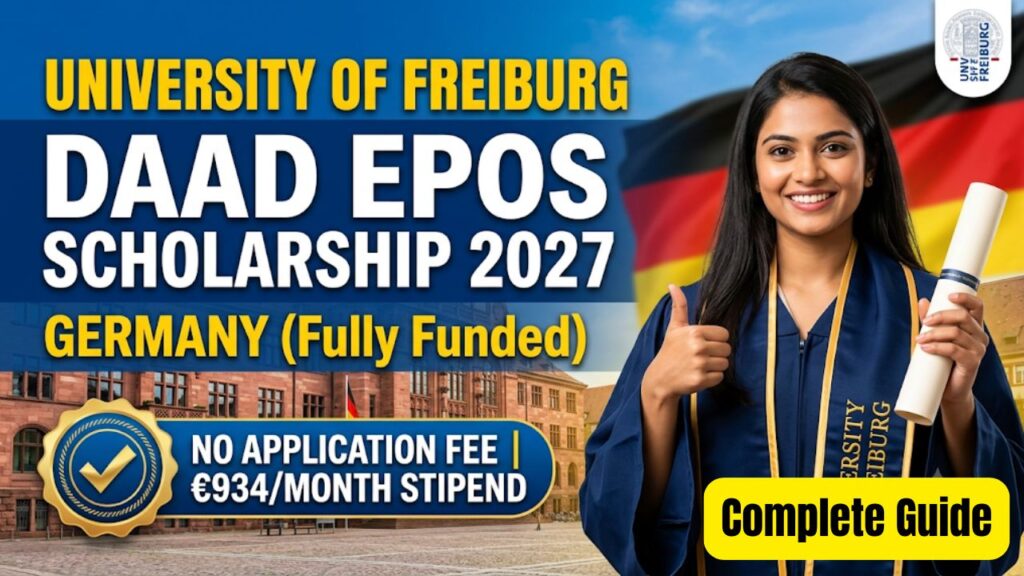
Germany stands out as a top global destination for higher education. The country offers world-class academic standards, rich cultural experiences, and highly advanced research facilities. Through the German Academic Exchange Service (DAAD), the Development-Related Postgraduate Courses (EPOS) program lifts the financial burden off international students. It covers your tuition fees, travel costs, and monthly living expenses entirely.
This comprehensive guide covers everything you need to know about the University of Freiburg DAAD EPOS Scholarship 2027. We detail the eligibility requirements, benefits, step-by-step application procedures, and crucial dates. Read on to discover how you can transition your career toward global sustainability without paying any application or tuition fees.
Key Highlights of the Scholarship
This table summarizes the core features of the University of Freiburg DAAD EPOS funding program.
| Feature | Details |
| Host Country | Germany |
| Host University | University of Freiburg (Albert-Ludwigs-Universität Freiburg) |
| Degree Level | Master of Science (MSc) |
| Eligible Program | MSc Environmental Governance (MEG) |
| Funding Type | Fully Funded |
| Financial Benefits | Monthly stipend, tuition waiver, travel allowance, health insurance |
| Target Audience | Young professionals from developing countries (DAC list) |
| Application Fee | Zero (€0) |
| Application Window | June 15 to October 15, 2026 (For October 2027 Intake) |
Financial Benefits: What Does the Scholarship Cover?
The DAAD EPOS Scholarship provides complete financial security. Winning this scholarship allows you to focus entirely on your academic research and professional growth. The scholarship package covers several components.
- Full Tuition Fee Waiver: Non-EU citizens usually pay €1,500 per semester at the University of Freiburg. The DAAD EPOS scholarship completely waives this fee.
- Monthly Allowance: Recipients receive a monthly stipend of €934 to cover accommodation, food, and daily personal expenses.
- Travel Grant: The program pays for your round-trip international flight tickets from your home country to Germany.
- Health Insurance Coverage: The scholarship provides comprehensive health, accident, and personal liability insurance during your stay in Germany.
- German Language Course: DAAD funds a mandatory, intensive German language course before your regular academic classes begin.
Strathclyde International Masters Scholarship 2027
Eligibility Criteria
The selection committee enforces strict eligibility rules. You must satisfy both the DAAD EPOS general requirements and the specific admission rules for the MSc Environmental Governance program.
1. Target Countries
You must hold citizenship in a developing country or an emerging economy. The German Federal Ministry for Economic Cooperation and Development lists these eligible nations on the official DAC list.
2. Work Experience Requirements
You must possess a minimum of two years of relevant professional work experience. You must earn this experience after completing your bachelor’s degree.
- Accepted Work: Full-time or part-time employment in NGOs, government ministries, public agencies, or private green sectors.
- Excluded Work: The committee does not accept internships, voluntary work, or graduate assistantships. Academic roles like teaching or university research generally do not count as practical field experience.
3. Academic Qualifications
- You must hold an undergraduate degree (such as a Bachelor’s degree) in a relevant field.
- Your graduation date must not exceed six years at the time you submit your application.
- You must demonstrate an above-average academic track record. Your final grade must place you in the upper third of your graduating class.
- If you already possess a master’s degree, your motivation letter must explicitly justify why you require a second postgraduate degree.
4. Residency Rule
You must not have resided inside Germany for more than 15 consecutive months at the time of your application deadline.
5. English Language Proficiency
The entire MSc Environmental Governance program uses English as the medium of instruction. You must submit valid test scores before the designated deadline. The university accepts the following minimum scores:
- TOEFL iBT: 95 points
- IELTS Academic: Band 7.0
- Cambridge Certificate: Level C1
- Pearson Test of English (PTE): Score 76
Exemption Note: Native English speakers or applicants who completed their entire bachelor’s degree in the USA, Canada, UK, Australia, or New Zealand do not need to provide an English test score.
Required Application Documents
You must gather, sign, and merge all the following documents into a single PDF file. Organizing your documents correctly prevents immediate rejection by the admissions office.
- MEG Application Form: Download, complete, and sign the official institutional form.
- DAAD Application Form: Fill out the standardized development-related courses application form. Ensure you insert the current date of issue.
- Europass Curriculum Vitae (CV): Create a detailed CV using the mandatory Europass layout. You must present your history in reverse chronological order and explain any gaps longer than three months.
- Letter of Motivation: Write a professional statement up to two pages long. Explain your current job duties, your academic goals, and how this degree helps your home country. If you apply to other EPOS courses (maximum of three), you must submit the exact same motivation letter to all universities and state your priority order clearly.
- Academic Transcripts: Provide your official undergraduate records. The transcripts must display a numeric grading scale and your final Cumulative Grade Point Average (CGPA). You must attach certified English or German translations if the original document uses another language.
- Degree Certificate: Submit your official graduation certificate.
- Official Employment Certificates: Obtain formal letters from your employers on official company letterhead. The document must state your exact dates of employment, job responsibilities, and contain an original signature and stamp. Employment contracts or payslips do not satisfy this requirement.
- Two Letters of Recommendation: You need one professional letter from your current supervisor and one academic letter from a university professor. Important: Your referees must email these letters directly to the university. The admissions team rejects letters that applicants upload themselves.
- Signed DAAD Checklist: Print the official checklist, sign it by hand using a physical pen, and scan it back. Digital signatures invalidate this document.
- APS Certificate: This document remains strictly compulsory for all applicants who completed their studies in India, China, or Vietnam.
Step-by-Step Application Process
Follow this precise sequence to submit a valid application for the University of Freiburg DAAD EPOS program.
1.Complete the Online Eligibility Assessment:
Visit the official MSc Environmental Governance website and complete the Online Eligibility Assessment (OEA). This quick tool confirms whether your background matches the course profile.
2.Download and Prepare the Forms:
Download the official DAAD application form and the specialized MEG institutional form. Complete every field accurately. Ensure the information on your forms matches your CV and motivation letter exactly.
3.Request Letters of Recommendation:
Provide the university’s official referee guidelines to your current employer and your former university professor. Instruct them to email their signed and stamped letters directly to info-meg@unr.uni-freiburg.de before October 15.
4.Compile and Merge Into One PDF:
Assemble your forms, motivation letter, Europass CV, transcripts, degree certificates, work proofs, language test scores, and the hand-signed DAAD checklist. Merge these documents into a single PDF file. Arrange them in the exact order requested by the university.
5.Submit via Email:
Send your single compiled PDF file as an email attachment to info-meg@unr.uni-freiburg.de. Use a clear subject line containing your full name and your application type.
Important Dates and Application Deadlines
Keep track of these key dates to ensure your application progresses smoothly through the evaluation cycle.
| Date / Timeline | Milestone Event |
| June 15, 2026 | Online application portal opens for the 2027 intake |
| July – September 2026 | Official online Zoom Q&A info sessions at 14:00 CET |
| October 15, 2026 | Final closing deadline to submit the application PDF and recommendation letters |
| October 31, 2026 | Last day to submit delayed English language test scores |
| February 2027 | Notification of initial results and short-list interview invitations |
| October 2027 | Official commencement of the academic semester in Freiburg |
Institutional Contacts and Support
If you experience technical issues or require structural clarifications regarding your application materials, use the official university channels below.
| Channel | Contact Detail / Access Link |
| Primary Email Support | info-meg@unr.uni-freiburg.de |
| Official Zoom Link | [https://uni-freiburg.zoom-x.de/j/66437791635](https://uni-freiburg.zoom-x.de/j/66437791635) |
| Meeting Passcode | Sm4IaaUi6AmCcOhTtab4ogtJNVYSdV.1 |
| Consultation Hours | Select dates at 14:00 Central European Time (CET) |
Official Government and Institutional References
Always verify policy rules and download forms directly from official administrative portals.
| Source Authority | Resource URL |
| University of Freiburg MEG Portal | MSc Environmental Governance Admissions |
| DAAD Scholarship Database | DAAD EPOS Program Profile |
| BMZ DAC Nation List | Official Developing Countries List PDF |
| Europass Portal | Create a Mandatory Europass CV |
Pro-Tips to Make Your Application Stand Out
Because the university receives hundreds of applications for a limited number of EPOS slots, competition remains intense. Apply these practical strategies to maximize your selection chances:
- Eliminate Professional Gaps: The selection committee strictly verifies timelines. Account for every period in your CV. If you took time off for family care or medical reasons, list it clearly.
- Match the Motivation Focus: The MEG program focuses on environmental policy, governance, and societal management. Do not frame your motivation letter around pure laboratory science or technical engineering. Emphasize how you plan to manage natural resources and influence public policy.
- Verify the Grading Scale: If your home university does not use a common 4.0 GPA or percentage system, attach an official letter explaining the grading metrics. The admissions team automatically disqualifies applications with unreadable or qualitative grades.