Are you a future leader from a developing country? Do you want to bring real social justice and political growth to your home nation? If yes, the DAAD Helmut-Schmidt Scholarship 2027/28 offers you the perfect path.
This prestigious funding scheme supports young professionals who want to study Public Policy and Good Governance in Germany. The German Federal Foreign Office funds this fully-covered program. It aims to train highly qualified graduates in law, economics, political science, and administration.
This comprehensive guide covers everything you need to know about this career-changing opportunity.
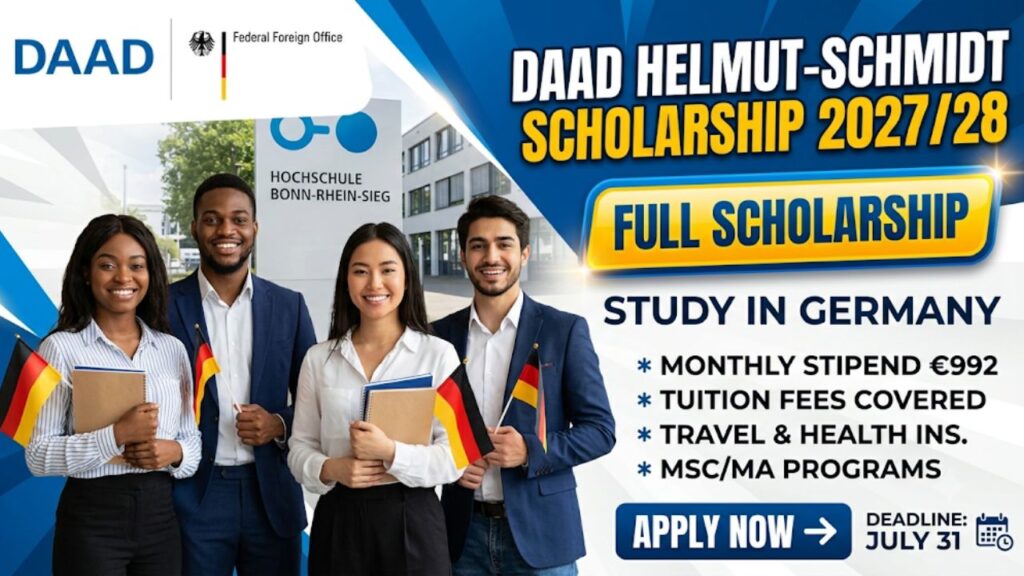
Key Highlights of DAAD Helmut-Schmidt Scholarship 2027/28
The table below summarizes the core features of this fully funded Master’s program:
| Category | Details |
| Funding Organization | German Academic Exchange Service (DAAD) |
| Sponsor | German Federal Foreign Office |
| Target Group | Graduates from developing and emerging countries |
| Degree Level | Master’s Degree (MSc, MA, MPP) |
| Coverage Type | Fully Funded (Tuition, living costs, travel, and health insurance) |
| Current Monthly Stipend | €992 per month (plus special rates during certain semesters) |
| Language of Instruction | Mainly English (some courses may require German) |
| Application Window | June 1 to July 31 (Annually) |
Financial Benefits: What Does the Scholarship Cover?
The DAAD Helmut-Schmidt Scholarship provides exceptional financial relief. It allows you to focus entirely on your academic and professional development. Selected scholars receive the following benefits:
- Monthly Stipend: You get a monthly allowance of €992 to cover your accommodation, food, and daily life expenses. During specific phases (like the fourth semester in certain programs like MSc Social Protection), the stipend adjusts to €500 per month.
- Health Insurance: The scholarship completely pays for your medical insurance coverage inside Germany.
- Travel Allowances: You receive financial support to cover your flight tickets from your home country to Germany and back.
- Study and Research Grant: The program provides regular grants to help you buy textbooks, laptops, and research materials.
- Rent Subsidies and Family Allowances: You might qualify for extra monetary support if your rent is high or if you travel with family members.
- Mandatory German Language Course: DAAD pays for a mandatory, intensive German language course. This course lasts up to four months (usually from June to August) before your actual master’s program begins.
Eligible Fields of Study and Master’s Courses
The scholarship supports specific master’s programs at selected German universities. These courses focus on areas that accelerate socio-economic progress in the Global South. For example, the Hochschule Bonn-Rhein-Sieg (H-BRS) offers a highly competitive MSc in Social Protection under this initiative.
Other participating universities offer specialized programs in:
- Public Policy
- Good Governance
- Public Management
- Development and International Relations
- International Law
Note: You must apply directly to the specific master’s course at the participating university, not through the general DAAD portal.
Strict Eligibility Criteria
The selection committee enforces high academic and professional standards. You must fulfill all the requirements listed below to receive consideration:
- Country of Origin: You must hold citizenship in a developing or emerging country. DAAD maintains an official DAC list of eligible nations.
- Academic Degree: You must possess a relevant bachelor’s degree. Common fields include economics, political science, law, international relations, or psychology. For specialized courses like the MSc in Social Protection at H-BRS, your transcript must show at least 15 ECTS credits in related subjects if your degree title differs.
- Professional Experience: You need a proven track record of practical experience in a relevant field. For instance, some courses require at least 5 months of paid or volunteer work in social protection, NGOs, or public administration.
- Language Proficiency: You must show excellent command of the English language. Most programs require a minimum C1 level proficiency. You can prove this through certified language tests or an official letter from your university confirming English as the medium of instruction.
- Academic Recency: Your last academic degree must not be older than six years at the time of your application.
Important Dates and Timelines
Missing a deadline will result in automatic rejection. Mark these key dates on your calendar for the 2027/28 academic cycle:
| Event/Phase | Date/Timeline |
| Application Period Opens | June 1 |
| Application Deadline | July 31 |
| Online Information Sessions | Early July (e.g., H-BRS hosts WebEx sessions on July 1) |
| Shortlisting and Online Interviews | Late October to November |
| Final Selection Results | December to January |
| Mandatory Language Course | June to August (Pre-semester) |
| Master’s Course Starts | September/October |
Step-by-Step Application Procedure
You must follow the formal guidelines perfectly. The universities reject incomplete files instantly. Follow these exact steps to complete your application:
Step 1: Download Official Forms
Visit the official DAAD database page. Scroll to the bottom and download the official DAAD Application Form and the mandatory DAAD Checklist.
Step 2: Write Your Motivation Letter
Draft a detailed motivation letter. It must explain your academic, personal, and professional reasons for choosing the course. You must physically sign and date this document. Keep it under two pages.
Step 3: Prepare Your Research Proposal
Create a structured research proposal if your chosen university requires it. For example, H-BRS requires a maximum of 800 words. Your proposal must outline your topic, research question, literature review, theoretical framework, and methodology.
Step 4: Format Your CV
Build a full Europass Curriculum Vitae. Arrange your experiences in reverse chronological order. You must explain any employment or academic gaps that last three months or longer. Do not forget to add the current date and your physical signature.
Step 5: Gather Official Proofs
Collect your certified university degree certificates and complete transcripts. Attach a detailed explanation of your university’s grading system. Gather your official language test certificates and written proof of work experience on company letterheads.
Step 6: Submit via the University Portal
Upload all documents to the specific university’s portal (such as the Apollo portal for H-BRS). Do not send your application via email. The selection committee ignores email applications completely.
Critical Warnings for Applicants
- Signature Rule: You must hand-sign the DAAD application form, the checklist, your CV, and your motivation letter. Digital font signatures often cause rejection.
- Word Limits: Keep your papers within the strict word count boundaries. The committee discards essays that exceed the length limits.
- Document Authenticity: The university cross-checks all submitted items. Any forged or altered documents cause immediate, permanent disqualification.
- Translation: If your certificates use a language other than English or German, you must provide a certified translation from a registered translator.
Official Support and Help Desks
If you face any issues during your application, reach out to the university coordinators directly.
| Institution / Department | Contact Channel |
| Hochschule Bonn-Rhein-Sieg (Social Protection) | fb06.helmut-schmidt-programm@h-brs.de |
| H-BRS Course Coordinators | fb06.coordinators-msc-socialprotection@h-brs.de |
| H-BRS Campus Address | Room F209, Grantham-Allee 2-8, 53757 Sankt Augustin |
| DAAD General Support | Via the official DAAD Scholarship Database Contact Form |
Government and Official References
Always trust official government platforms for updates regarding changes in stipends, rules, or country lists.
| Source Authority | Official Reference Link |
| DAAD Official Database | DAAD Helmut-Schmidt Programme Portal |
| Hochschule Bonn-Rhein-Sieg Portal | H-BRS Helmut-Schmidt Scholarship Page |
| German Federal Foreign Office | Auswärtiges Amt Official Website |
What If You Do Not Get the Scholarship?
The selection process remains highly competitive. For example, H-BRS handles hundreds of applications but only awards a maximum of eight scholarships per cycle.
If you miss the scholarship shortlist but meet the basic entry criteria, do not lose hope. You can re-apply to the university as a regular student during the open admission phase starting December 1. Regular international students in Germany can work part-time jobs up to 140 full days per year to support their living costs. You can also explore alternative funding networks like the ADSP scholarships.
Prepare your documents early, write a compelling motivation letter, and submit a flawless application to secure your future in Germany!