The U.S. National Science Foundation (NSF) officially announced the inaugural awards for the CyberAICorps Scholarship for Service (CyberAI SFS) program on July 28, 2026. This initiative marks a major expansion of the long-standing CyberCorps Scholarship for Service program. As artificial intelligence transforms both cyber defense and cyber risks, this program bridges the gap between artificial intelligence (AI) and cybersecurity education.
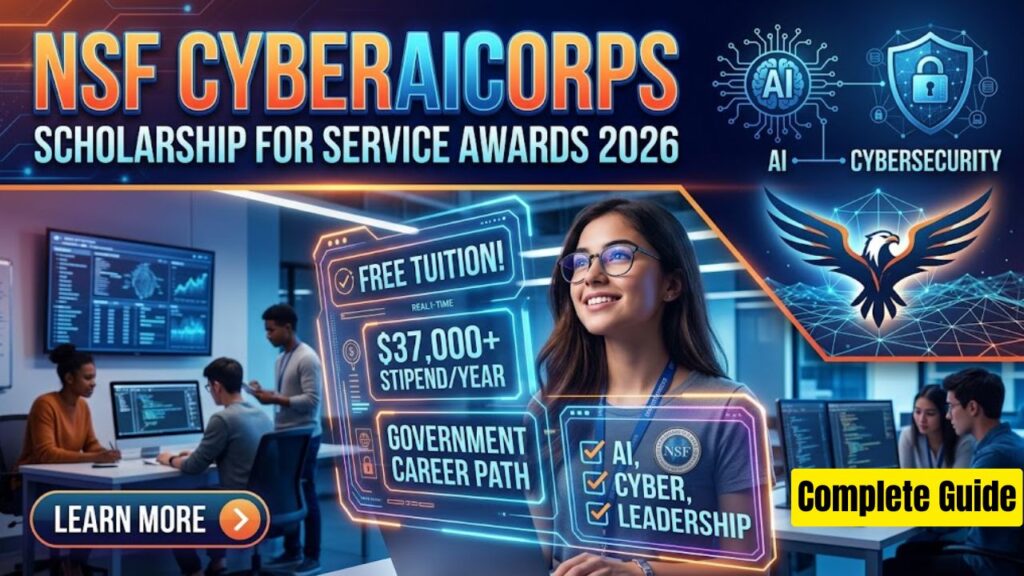
The CyberAICorps program provides full academic scholarships, generous stipends, and professional development support to students. In exchange, graduates work in cybersecurity or AI roles within government agencies. This initiative prepares a new generation of skilled professionals to defend critical digital infrastructure against evolving cyber threats.
What is the NSF CyberAICorps Scholarship for Service Program?
The CyberAICorps Scholarship for Service program is a joint initiative managed by the National Science Foundation in collaboration with the U.S. Office of Personnel Management (OPM) and the U.S. Department of Homeland Security (DHS).
The program addresses a critical shortage of technical talent across local, state, federal, tribal, and territorial government bodies. Today, cyber attackers use automated tools and artificial intelligence to breach networks. Government agencies need experts who understand both artificial intelligence and traditional computer security.
The CyberAICorps program focuses on two main areas:
- CyberAI Defense: Teaching cyber specialists how to apply AI models for threat detection, rapid incident response, and digital forensics.
- AI System Security: Training students to design resilient AI systems that resist adversarial attacks, data poisoning, and manipulation.
Rosa Luxemburg Foundation Scholarship
Key Highlights of CyberAICorps Scholarship 2026
The table below summarizes the key details of the NSF CyberAICorps program:
| Parameter | Details |
| Program Name | CyberAICorps Scholarship for Service (CyberAI SFS) |
| Sponsoring Agency | National Science Foundation (NSF) |
| Partner Agencies | U.S. Office of Personnel Management (OPM) & Department of Homeland Security (DHS) |
| Announcement Date | July 28, 2026 |
| Inaugural Awardees | 14 Colleges and Universities across the U.S. |
| Scholarship Coverage | 100% Full Tuition and Academic Fees |
| Undergraduate Stipend | $25,000 per year |
| Graduate Stipend | Up to $34,000 – $37,000 per year (depending on degree level) |
| Professional Allowance | Up to $6,000 per year (for books, travel, certifications) |
| Service Obligation | Mandatory government service equal to the duration of the scholarship |
| Target Audience | U.S. Citizens and Lawful Permanent Residents in AI & Cybersecurity degrees |
Major Features and Benefits for Students
The CyberAICorps program offers comprehensive financial and professional backing to enrolled scholars.
1. Complete Financial Support
The scholarship covers full tuition and mandatory academic fees at participating universities. Students do not need to take out student loans or pay out-of-pocket tuition costs during their award period.
2. Generous Living Stipend
Undergraduate scholars receive an annual stipend of $25,000. Graduate students (Master’s and Ph.D. candidates) receive higher annual stipends to cover their living expenses completely while they focus on their studies.
3. Professional Expenses Allowance
Each scholar receives up to $6,000 per academic year. Students use these funds to purchase textbooks, pay for industry certifications, attend technical conferences, and buy specialized research materials.
4. Hands-on Training and Internships
Scholars gain practical experience before they graduate. Participating universities provide faculty-mentored research, virtual cyber labs, hands-on capstone projects, and guaranteed summer internships with government organizations.
5. Direct Pathway to Public Service
The program connects scholars directly with federal recruiters through specialized job fairs and career events. Graduates start their careers immediately in government agencies without navigating standard civil service job hurdles.
Slovakia €15000 Scholarship for International Students
List of Awarded Universities for FY 2026
The NSF selected 14 premier higher education institutions in its inaugural FY 2026 funding cycle. These colleges and universities developed high-quality academic curricula combining AI and cybersecurity.
The inaugural recipient institutions include:
- Arizona State University (Arizona)
- Augusta University (Georgia)
- California State University, San Bernardino (California)
- Michigan Technological University (Michigan)
- New Jersey Institute of Technology (New Jersey)
- Old Dominion University (Virginia)
- Texas A&M University (Texas)
- University of Central Florida (Florida)
- University of New Haven (Connecticut)
- University of Rhode Island (Rhode Island)
- University of West Florida (Florida)
- The University of Texas at Dallas (Texas)
- The University of Texas at El Paso (Texas)
- Vanderbilt University (Tennessee)
Eligibility Criteria for Applicants
Students must satisfy specific academic and citizenship criteria to qualify for a CyberAICorps scholarship at an awardee university.
- Citizenship: Applicants must hold U.S. citizenship or lawful permanent resident status.
- Academic Enrollment: Students must enroll full-time in an eligible undergraduate or graduate degree program (Informatics, Computer Science, Cybersecurity, or AI) at a participating university.
- Academic Performance: Applicants must maintain a minimum cumulative Grade Point Average (GPA) of 3.0 on a 4.0 scale.
- Time to Graduation: Undergraduate candidates must stand within two years of completing their degree requirements.
- Security Clearance Eligibility: Applicants must meet the criteria necessary to obtain a U.S. federal security clearance.
- Service Commitment: Candidates must sign an agreement promising to work in an AI or cybersecurity role for a government agency after graduation.
Service Obligation Explained
The CyberAICorps program operates on a “service for scholarship” model. In exchange for financial support, every student commits to public service.
- Duration: You must work one year in government service for every year you receive scholarship funding.
- Eligible Employers: Graduates can work for federal executive agencies (such as DHS, DoD, NSA, or FBI), state agencies, local municipal governments, tribal governments, or national research laboratories.
- Summer Internships: Scholars must complete a paid summer internship with a government partner during their scholarship period.
- Repayment Provision: If a student fails to complete the academic degree or breaches the service contract, the scholarship converts into a standard student loan that the recipient must repay.
Important Dates and Schedule
Understanding key timeline dates helps both academic institutions and interested students plan ahead.
| Event / Phase | Target Date |
| NSF Program Solicitation Release | February 2026 |
| Institutional Proposal Target Date (FY 2026) | April 3, 2026 |
| Institutional Deadline (FY 2027 Cycle) | July 21, 2026 |
| Inaugural Award Announcement | July 28, 2026 |
| Student Application Window | Varies by participating university (typically Fall 2026 / Spring 2027) |
| Academic Term Start for Scholars | Fall Semester 2026 / Spring Semester 2027 |
How to Apply for CyberAICorps Scholarship 2026
Students do not apply directly to the National Science Foundation. Instead, students apply directly through participating universities.
Step-by-Step Application Process for Students
- Select an Awarded Institution: Review the list of 14 funded universities and confirm that you attend or plan to attend one of these institutions.
- Contact the Campus Program Director: Reach out to the Principal Investigator (PI) or CyberAICorps program coordinator at your university’s Computer Science or Cybersecurity department.
- Gather Required Documents: Prepare your academic transcripts, resume, letters of recommendation, personal statement explaining your passion for public service, and proof of U.S. citizenship.
- Submit Campus Application: Complete the internal application form provided by your university before their stated deadline.
- Complete the Selection Interview: Selected finalists undergo panel interviews with university faculty and federal advisors.
- Accept the Award Agreement: Once selected, sign the official service obligation contract and accept your scholarship award.
Helpline and Support Contact Details
If you have questions about the CyberAICorps program, use the official agency contact channels listed below.
| Department / Agency | Contact Purpose | Official Email / Phone |
| NSF Directorate for STEM Education | General Program & Policy Inquiries | stemeducation@nsf.gov / (703) 292-8600 |
| CyberCorps SFS Central Office | Scholarship Administration & Service Placement | sfs@opm.gov |
| NSF Public Affairs Office | Media & Press Inquiries | media@nsf.gov / (703) 292-7000 |
| NSF Help Desk | Technical Support | fastlane@nsf.gov / 1-800-673-6188 |
Official Government References
The table below lists the official government publications, announcements, and policy resources for verification.
| Resource Name | Source Agency | Official Link |
| NSF Inaugural Press Release (July 28, 2026) | National Science Foundation | NSF Announcement Page |
| CyberAI SFS Program Solicitation (NSF 26-503) | National Science Foundation | NSF Funding Opportunity |
| CyberCorps Service Portal | Office of Personnel Management (OPM) | OPM SFS Portal |
| NSF Main Portal | National Science Foundation | NSF Official Website |
Final Thoughts
The NSF CyberAICorps Scholarship for Service Awards represent a landmark investment in America’s technological defense. By uniting artificial intelligence with cyber defense training, the U.S. government ensures that its workforce stays ahead of modern digital threats. Qualified students gain an extraordinary opportunity to receive tuition-free education, substantial living stipends, and guaranteed career placement in public service. Interested students should contact participating universities immediately to submit their applications for the upcoming academic cycle.